The Spirit, the Word, and the Heart of St. Catherine of Siena (c. I-IV)
I. A Singular Adolescence
Catherine was born in Siena, daughter of Jacopo Benincasa, a dyer of the people yet of comfortable means, and of Lapa, who, among many children, nursed only Catherine at her breast.
From her earliest years, she adorned the grace of the innocence years with the fire of a fervent piety. From the lives of the Desert Fathers, she conceived a love for solitude so deep that one day, with only a piece of bread, she wandered alone beyond the city walls to a hidden place, cave-like and silent. Yet God—surely through the hands of her parents—called her back.
Later, hearing of a holy woman who had taken up her dwelling in a secluded gathering of hermits, where each cell stood as a cloister unto itself, Catherine imagined she might do likewise. Disguised, she hoped to enter the company of the Dominican friars—as though foreshadowing the vocation that would one day make her, alone among women, a preacher of truth. Yet her confessor, with gentle firmness, dissuaded her and turned her zeal toward the souls of her companions. These she began to gather about her, and to them she spoke of God.
Her sister, who was already married, and her mother urged her to care for her appearance so that she might please others. Catherine, in obedience, consented, though she recoiled from the thought of earthly marriage—and afterward wept over this as if it were a sin. When her mother proposed to give her hand to a young relative, Catherine, to prove her contrary resolve, cut off her hair, which was most beautiful. Then came reproaches at home, menial tasks imposed upon her, and the loss of her little room—her refuge for prayer.
Her perseverance first won over her father, and in time, all the others. When she reached the age of fourteen, she declared plainly that her life, from childhood, had been consecrated entirely to God—whether they chose to keep her as a servant or cast her out.
Sparing of food and sleep, she wore a hair shirt and scourged herself. When taken, as a test of her resolve, to the public baths—then places of leisure and amusement—she plunged into the hot sulfurous waters to prove to her mother the steadfastness of her will.
Lapa appealed to the Mantellate, the women of the Third Order of St. Dominic, to accept her daughter—perhaps hoping they would refuse. And refuse they did, being unaccustomed to admitting young girls, preferring widows instead, as each lived not in common but in her own home.
Struck then by a dangerous case of smallpox, Catherine, burning with fever, moved her anxious mother—fearful for the life she now cherished—to plead once more with the Mantellate. This time they agreed, provided Catherine was not of too striking a beauty. The smallpox, which then covered her, hid from the devout sisters the grace of her delicate features.
In the year 1362, Catherine became the first virgin to wear their habit, though they did not take formal vows. But with that liberty, they renewed each day the merit of their offering.
II. Private Acts of Charity
For three years, Catherine remained austere and silent, amid battles of temptation and visions of heaven—realities that would alternate throughout her wondrous life.
The death of her father brought her deep sorrow. Anguish came, too, with her mother’s illness—unreadied for death—whom legend says was restored through Catherine’s prayers, that is, delivered from mortal danger.
God spoke to her heart. And from the little chamber where she was nourished by adoration and fasting, He began to draw her forth. Her long-held scruples now overcome, she rejoined her family at table and began, for the sake of charity, to face human conversation.
That charity she began to exercise toward her fellow citizens, preaching peace and justice, which is the foundation of peace. Soon, the people of the Sienese lands began to invoke her as a powerful peacemaker, and her words would extinguish fierce hatreds. If she conquered hatred—the most deadly enemy of true religion and of the human soul—then we may well believe she overcame also other passions and hardened vices.
At her voice—at the mere sight of her—hearts were changed. There were not enough priests to hear the confessions of those converted by her witness. Thus Pope Gregory XI sent her through the Sienese territories on an apostolic mission—an act without precedent. It was as though, by his decree, the Pope obeyed the prophetic inspiration of that young girl who had once wished to walk among the friars.
In the year 1374, when famine was followed by plague—a scourge that spread across many regions and extinguished a dozen cardinals in Avignon—Catherine, with a most courageous mercy, became the comfort of Siena’s desolation. And it required no less bravery to face death in caring for the sick than to exhort the people of the city not to draw bodily peril upon themselves by means of their spiritual ruin—for in such times of scourge, the soul, tormented by fear, often seeks in the pleasures of vice a desperate refuge.
She continuously brought comfort and alms to the hospitals, and in Siena the lantern she carried on her holy visits is still preserved. Yet from this came mortal peril to her virginal reputation.
A widowed tertiary, whom Catherine had patiently cared for in a case of foul gangrene (as it often happens that great kindnesses provoke the pride of the vile to vengeance, who despair of ever repaying them), conceived shameful suspicions against the amable woman—and spread them.
Many among her fellow Mantellate, with that credulity toward evil to which certain devout souls are prone, drank in the poison and returned it in mockery and scorn. Yet Catherine—disobeying even her mother, who advised her no longer to care for the ungrateful slanderer—persevered. She bore the corruption of that soul, more loathsome than the gangrene of the body.
And by conquering herself, she conquered the other. The woman at last confessed to her false accusation, and the virgin’s honor only increased in the eyes of all.
Likewise, Catherine bore the constant insults of a leprous woman, whom she served with such faithful care that the leprosy clinged even to her own most pure limbs.
III. Public Acts of Charity
Another kind of leprosy, another contagion, put to the test both the virile strength of her spirit and the gentleness of her heart: I speak of suspicion, that worm which gnaws at republics and every intemperate form of government.
Among the Sienese—where, at the time, the party of the people held sway—there arose bitter complaints when they saw Catherine dwelling for some time in a fortress of the Salimbeni, a family whose power seemed dangerous to the common folk. Their grievance may not have stemmed so much from fear that she would take sides, as from resentment that others might wield the authority granted her by the grace of her virtue and by her words strengthened through extraordinary deeds.
But she responded to these complaints with forgiveness and with prayers—for her country, loved in all its children. Siena was to her as a family, and the Church was her homeland.
She feared the residence of the pope in Avignon—surrounded by cardinals, nearly all French, besieged by the powers and intrigues of the French court—might become a calamity for the Church. For this reason, she called the pontiff back to Rome.
It is not certain that she gave this counsel to Urban V, who in 1367 had returned to Rome amid citywide celebration, with a procession of prelates and princes, and with Amadeus VI, Duke of Savoy, riding at his right hand like a proud equerry. But that French pope soon returned to France, and there died two months later, as Saint Bridget had foretold, in the year 1370.
To Gregory XI, newly elected, Catherine now turned: to urge his return to Italy, to stir him to preach a Crusade, and above all to exhort him to a reform of the Church and of himself. She laid bare to him the failings of the clergy and the afflictions of the people, warning him to guard against the affection he showed his nephews—a weakness from which her corrections helped to heal him.
Summoned by the family of Pietro Gambacorti, lord of Pisa, she was received there with great honor by the citizens, who invoked her as a spiritual teacher and a marvelous healer, even of bodily illness. There too she spoke in favor of the Crusade, and held a private discourse with the ambassador of the Queen of Cyprus.
She wrote on the matter to Niccolò Soderini, a powerful figure in the Florentine Republic, and to Giovanna of Naples, the beautiful and infamous queen. She also addressed letters to mercenary captains, seeking with sacred intent to turn them away from their ignoble trade; and one of the most famous among them—the Count of Warwick (Sir John Hawkwood, known in Italy as il Conte Aguto)—promised his support with his men.
And beyond her letters, she sent forth trusted messengers to carry her appeals.
IV. Political Mediation on Behalf of Florence
During her journey to Pisa, Catherine also visited Lucca and counseled that republic not to oppose the pope—in whom she venerated the supreme dignity of the Church and in whom she hoped to see a bond of civil concord for all of Italy. She gave similar counsel to many other cities; and to the pope himself, she never ceased to recommend clemency and the governance of a father.
While in Pisa, in the Church of Santa Cristina, after receiving Holy Communion, she saw from the Crucifix five rays of light, which struck her and imprinted upon her senses the agony of the sacred wounds. That Crucifix was solemnly translated to Siena in the year 1565, and it is venerated there to this day.
Summoned by the Carthusians to the island of Gorgona, she went there with a group of other sisters, and she preached to the monks. With a heart refined by experience, she discerned the secrets of their souls, and they stood in awe of her wisdom. Yet a doctor and a lawyer in Pisa, contemptuous of such wisdom, attempted to entrap her with a pedantic scholastic question. But Catherine, responding as a woman with the discerning simplicity of a righteous spirit, answered so wisely that the two learned men were humbled and bowed before her.
In 1375, she returned to her little cell in Siena; yet from there, her words and affections spread across Italy and embraced the whole of Christendom.
Florence, provoked by the poor governance exercised over Italian cities by papal legates—whose ambitions, suspected of seeking territorial gain, stirred unrest—and incited by the wicked prince Bernabò Visconti, rose up in rebellion against the pope. Encouraged by the strong spirit of Florence, many other Italian cities followed suit.
Catherine, on both sides, strove to restrain the fury of men with words of meek yet holy severity, but neither party would yield.
Against Florence the pope hurled an anathema. Then, shaken—perhaps by the threat to its commerce, or by the scandal and dismay that such a sentence might sow among its citizens and allies—the city, whether out of sincere repentance or simply to gain time, sought peace. That city of merchants and warriors, rich in politicians, orators, and saints, chose as her ambassador to the pope the poor woman of Siena—placing her hope in the ardor of her speech and charity, in the affectionate veneration she inspired, and in the very singularity of so gracious a mediation.
In May of 1376, Catherine came to Florence. She had already been there two years prior in order to obey the superior of her Order, and had then become known to the Florentines up close. She now encountered the full difficulty of peacemaking.
Chief among the obstacles was the faction of the Ricci, then in power, who would have to yield to the Guelf Albizzi were peace to be restored. Another obstacle lay in the multitude of magistracies, which, rather than calming mutual suspicions, only fueled them—thus dissolving rather than uniting the republic.
Catherine—whether she believed the root of the evil must be torn out (that is, the misrule of the papal legates), or whether she held that the priest, as minister of mercy, ought to be the more generous—sent envoys and a letter to the pope. In it, she pleaded with him to come to Italy: to curb abuses and to revive through his goodness the errant.
V. Legation to the Land of France
Meanwhile there came the Bretons, soldiers of the Pope—living anathemas—to make Italy's wounds bleed afresh.
At the entreaty of the Florentines, the modest virgin, the gentle woman, the daughter of Jacopo the dyer who dwelt on Via dell'Oca, crossed the Apennines and the Alps as ambassador to the Avignonese court, where for so many years had lived the political poet, the gallant canon, the singer of Madame de Sade. Setting out at the end of May, she arrived at Avignon on the eighteenth day of June with three companions and about twenty other disciples: religious from various orders, and lay gentlemen from Siena and Pisa. They were lodged in a beautiful house with a most splendidly adorned chapel.
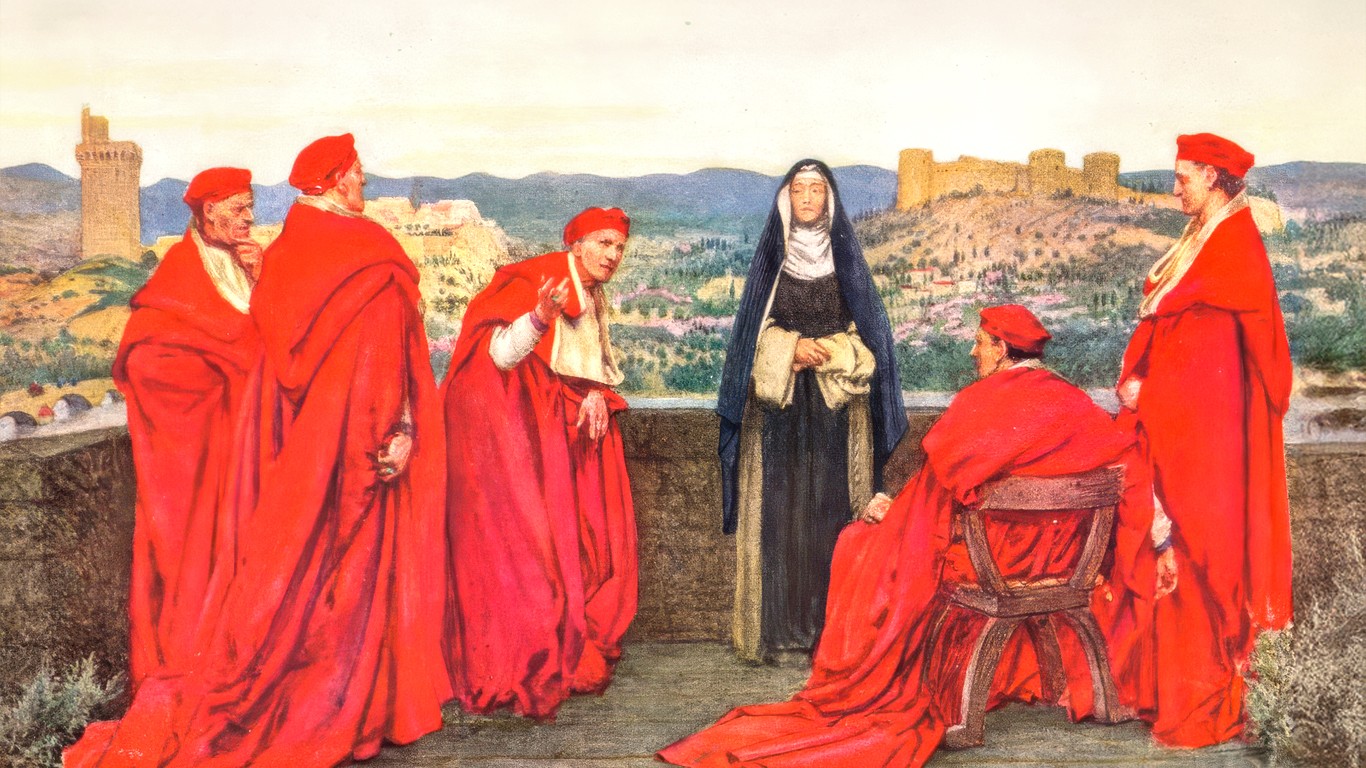
Two days later the Pope, a Frenchman, with the cardinals assembled in consistory, heard the cause of the Mantellata, translated for him by a friar from Tuscan into Latin; and, moved by her words, entrusted the whole matter to her, commending to her only the honor of Holy Church.
Catherine entered into conference with cardinals and with temporal lords, who even then, to the Pope's own satisfaction, meddled in the affairs of the papacy. But the rumors spread against the Florentines, the delay of their ambassadors, and the evasions of those same ambassadors—who had come ill-disposed, and with foolish discourtesy declared that they would negotiate not with her but with the Pope—put her ardent and guileless heart to trials of an uncommon patience.
Yet she never wearied of crying out for peace, while at the same time waging war upon the vices of prelates and upon the designs of France, which desired to keep the Apostolic See at Avignon.
Three French prelates assailed her: first with insolent questions concerning her political mission, then for hours with deceitful disputations on spiritual matters. Catherine sent them away confounded. Others freely confessed that never had any man spoken as this woman spoke.
Certain noble ladies of Avignon, wishing to ensnare her beneath the appearance of piety, found themselves instead laid bare by a few simple words; she showed that she knew them for what they were, and departed.
The Pope's niece, while Catherine—receiving Holy Communion as was her custom, barefoot save for half-covered feet, and wholly absorbed in ecstasy—stooped as though to venerate her, and pierced her feet with a needle. Catherine neither felt it nor stirred, though blood flowed. This fact has even been rendered credible by the demonstrations of modern science. Yet the cause of such estrangement from the senses may indeed be almost mechanical—or, as here, may proceed from the innermost power of the spirit.
VI. She Brings About the Pope's Deliverance from Avignon
What Bridget, Queen of Sweden, could not obtain during her lifetime by her threatening revelations (that the Supreme Pontiff should return to Rome and establish there his fixed See), was won by the loving prayers of the humble daughter of the Sienese republic.
Of the twenty-six cardinals, only four were Italians, one was Spanish, and all the rest French, clinging to that abode out of convenience, vanity, and fear of Italy's endless discords.
Gregory was not made of so stout a breast as Urban, who, when the cardinals opposed the return, threatened to make the Sacred College Italian, saying that beneath his cardinal's cap he had cardinals enough to his liking. Yet he himself, after setting foot in Italy, took flight.
They sought to terrify Gregory with lying tales of poison that awaited him in Rome, and they circulated forged letters under the name of a man reputed to be a saint.
The strong woman encouraged him to be a man; and by eloquently dispelling both the suspicions themselves and even the appearance of their plausibility, she displayed a knowledge of human affairs rarely found even among statesmen. She reasoned thus with the cardinals; she argued the matter openly in consistory.
Then the courtiers devised a new stratagem. Knowing how ardently she longed for the Crusade, they began to spread the notion that France—warlike, and less torn by internal divisions—was the more fitting place from which to prepare it.
Thus they employed the Saint herself against the Saint.
They did not know that great souls, even more than great intellects, possess the power to reconcile great things one with another.
Indeed, she herself had urged that Duke of Anjou to take command of the Crusade—that same duke who, on behalf of his royal brother, had come to fasten the Pope anew to France; and perhaps more through the power of her deeds and of her very presence than through her words, she changed, or at least weakened, his troublesome design.
The Pope, held back by love of country and of kindred, by the comfort of his dwelling, and by the devoted reverence of the French, was at last overcome—or rather, he overcame himself.
For when Catherine, questioned by him as though asking fresh counsel whether he ought to depart or remain, revealed herself to know of the vow he had made before becoming Pope—a secret vow, known only to God—to return one day to Rome.
The tears of his father, the sorrow of the city, could not restrain him. And in September of the year 1376, amid the weeping people of Marseilles, he embarked in tears for the shores of Italy.
Twenty-two ships accompanied him, one belonging to the rebellious Florentines, yet rejoicing in his return as a blessing common to all; perhaps also proud that such a victory had been won by a Tuscan woman; perhaps wishing to display generosity and clemency, and to yield to that party within their divided city which condemned the war and feared its consequences.
As the courtiers—and even the Pope's own beasts of burden—seemed to recoil from leaving Avignon, so too sea and sky, with their tempests, appeared determined to drive him back.
But fiercer than all those storms was the unrest of the Romans, who feared the Pope as an oppressor of their ancient liberties.
Catherine—whom the Pope would not allow to leave France before him, wishing to strengthen himself by the heavenly vigor of this woman—came by way of Toulon to Genoa, where he, frightened by Roman threats, was already hinting in consistory that he wished once again to flee.
She calmed the storms of his soul by the power of her virginal word.
And to make herself worthy of that mission, she spent the nights in prayer, offering her very life to God.
At last, after further tempests at sea, and delays at Livorno and Corneto, after a journey of fully four months, Gregory beheld Rome—a city that for more than seventy years had lacked its own bishop.
The bells rang out in jubilation. The streets were strewn with flowers. The night blazed with countless torches. The people, exultant and weeping, stretched forth their arms, prostrated themselves, danced for joy. Behind the Pope's steed rode richly arrayed noblemen and bishops in full pontifical vesture; a thousand performers came forth to greet him.
Catherine was absent from the triumph.
Already her little cell at Siena had reclaimed her.
And by not being there, she shone all the more.
by
Read more